I just heard the news that Major Richard D Winters passed away on January 2, two weeks before his 93rd birthday. Dick Winters was the commander of Company "E", 2nd Battalion, 506th Parachute Infantry Regiment, 101st Airborne Division, US Army, popularly known as "Easy Company", who's exploits were told in the HBO miniseries Band of Brothers. In the series, Major Winters was portrayed by Damian Lewis, and Winters added some commentary to the series along with other surviving members of Easy Company.
Winters and his men parachuted into Normandy in the dark morning of June 6, 1944, and began to fight their way across France, Belgium, the Netherlands and into Germany. D-Day, the Bulge, the siege of Bastogne, and into Hitler's Germany; Winters and Easy Company were there. He was one of the dwindling numbers of our Greatest Generation, one of those men and women who fought to save civilization during World War II and then went home to post war America and set the stage for what would be the zenith of the American Century.
His was a remarkable story, and he led an extraordinary life.
We are all in his debt, as we are to all who served in that era. My condolences to his loved ones, and here's a final salute a man who's story and that of his comrades will live for generations.
For more on the life of Major Dick Winters click here.
Grandpa fought under General "Black Jack" Pershing in the Argonne Forest in 1918 after America entered the First World War.
Dad joined the Navy on May 3, 1945, less than a month after his 18th birthday. Germany surrendered while he was in boot camp, and Japan did the same while he was in San Diego, preparing for the proposed invasion of the home islands.
One uncle on my mother's side was one of the men pinned down on Omaha Beach on June 6, 1944, and a cousin was one of the Marines killed at Peleliu in the Pacific.
My father's brothers served in the 1950's, one in Air Force, and another in the Army- he went Korea and fought at Inchon.
In the early 1970's the Vietnam War was dragging on; I joined the Air Force, and served during the war's last years and for almost half of that decade. I never saw combat, and my overseas experience consisted of two years in the UK. I participated in a lot of war games when my unit was attached to a British Army company in NATO exercises. I liked hanging with the Brits. They knew how to do it right; they had tents for officer's, NCO's, and enlisted men's clubs that had fully functioning bars and kegs of beer on tap. No wonder the Germans couldn't beat those guys- they fought for King, country, and transportable pub.
I was one of the lucky ones. I was never in harm's way, I never had to fire a weapon in combat, I never had to kill or be killed. There are many of us who lucked out, and many who did not. I think of those who fell or came back damaged quite a bit, and of the cruelty and stupidity of war and of those who try to glorify it.
I did my job, and then returned to civilian life. But in many ways, my days in the Air Force were some of the happiest. It was probably because of the live for today attitude we had; a phone call from the CQ could be the notification to get packed, you're shipping to Southeast Asia. Some of my friends got that call; I never did
If you have a chance, thanks a vet or an active duty serviceman or woman today. It's shameful that the wars of the Middle East get so little press these days; our people deserve so much more than our apathy.
To any veteran or military member reading this.....thank you, very, very much.
THE PACIFIC TO BE SHOWN ON HBO For Veteran's Day
HBO will be presenting the entire ten episodes of The Pacific on Veteran's Day. If you didn't see it the first time or missed episodes, be prepared for an engrossing story centered on three young Americans and their experiences in the Pacific theater during World War II.
Both The Pacific and Band of Brothers will be available ON DEMAND on HBO until November 15. For those who haven't seen "BOB", it follows "Easy Company" from D-Day to the surrender and occupation of Germany in 1944-45.
This blog has 16 entries related to THE PACIFIC, including episode comments, a book review, and other commentary. One of the most consistent queries this blog gets is "whatever happened to Leckie and Stella?".
The answer, my friends, can be found on these pages.
While I was away on vacation I didn't get a chance to see the finales of two series I've been following regularly. HBO's TREME concluded its first season with some ends, some beginnings, and left the audience wanting just a bit more, whetting your appetite for Season Two.This story of life in New Orleans in the months after Katrina was as good as it gets, allowing the audience to figure out plots and relationships without having to be spoon fed every detail. And SHOWTIME'S royal soap opera THE TUDORS drew to a close in its fourth season, with curtain calls from some players from previous years. For anyone who wanted a continuation of the series to chronicle the lives of Henry VIII's children, this would prove to be an impossible task due to a decision regarding characters in Season One....but I'll talk about that later.
TREME's finale answered the big question of why John Goodman was never given star billing in the opening credits. Goodman was the closest thing the show had to a household name after his years on Roseanne, and his Creighton Bernette character was one of the pivotal roles on the show. But as we feared in the penultimate Episode 9, Creighton did indeed commit suicide, jumping into the muddy Mississippi from the ferry. And honestly, I don't think I've been so angry with a fictional character in years....he had a teenage daughter who adored him, and a loving wife Toni (Melissa Leo). His despair at what had happened to New Orleans on so many levels was just under the surface, yet his suicide came as a shock because viewers never really saw the level of his hidden pain. But it seemed like such a wasteful cop out; how could he leave the woman who loved him a widow, and his daughter fatherless? It seemed so selfish on his part. Toni felt a sense of anger at Creighton's exit, and so did the audience.
Janette (Kim Dickens) decided to exit New Orleans and visit her folks before going on to New York, not before a somewhat feeble attempt by on and off boyfriend Davis (Steve Zahn) to get her to stay. Annie (Lucia Micarelli) appears to be finished with Sonny ( Michiel Huisman) after finding her abusive and drug addicted ex in her bed with some inked up babe. By the end of the show Annie was sitting on Davis' steps- he missed Janette for about 30 seconds- with Annie needing a place to stay. Davis and Annie seemed to be a better match than Davis and the driven, hard working Janette. Annie, the beautiful and incredibly talented violinist busking the streets and venues of New Orleans was probably the one Davis need all along, but had yet to know it.
I really didn't know very much about Lucia Micarelli until fairly recently, and wondered if she was an actress who's playing was dubbed in. I guess I must have been living in a cave or something- Ms Micarelli is a onetime prodigy and graduate of the Julliard School . Though classically trained, she branched out into jazz, rock, and experimental genres while she was still very young.
She's been recording for years, and has toured with The Trans-Siberian Orchestra, Josh Groban, and Chris Botti, as well as recording her own releases.
And even some classic rock....she's performed with the legendary Jethro Tull. Below, a video from a performance with Ian Anderson and company.
The last 10 minutes of so of the TREME finale were brilliant. LaDonna (Khandi Alexander) and her family were at the funeral of her brother Daymo. During the service LaDonna flashes back to the day before Katrina hit the Gulf Coast. We see Antoine (Wendell Pierce) and his family evacuating New Orleans, LaDonna waiting in a gasline, Albert Lambreaux (Clark Peters boarding up windows), Sonny and Annie walking down a deserted New Orleans street, Davis getting ready to sit it out, and the Bernette family huddled around the TV watching THE WEATHER CHANNEL, with Creighton reassuring Sophia and Toni that Katrina will veer away and they'll be OK- but the expression on his face betrays him. And we see Daymo's arrest on the bench warrant, and his imprisonment, where he'll meet his death.
At the end of the service the brass band and the line marches away, New Orleans style. They sway, they dance, and eventually LaDonna joins in. Death comes, life goes on....and mourning morphs into celebration.
And New Orleans goes on.....and will again, even after this latest disaster, man made this time.
The Tudors ended with Henry's (Jonathan Rhys Myers) physical decline accelerating, preceded by the death of longtime friend Charles Brandon (Henry Cavill). Bishop Gardner's plot to have Queen Katherine Parr (Jolie Richardson) arrested as a heretic backfires, and Henry banished Gardner from court. Forseeing his own death, Henry sends Katherine and the Princesses Mary (Sarah Bolger) and Elizabeth (Laoise Murray) to Greenwich. And in his aged delusions Henry has visions of the three mothers of his three legitimate children (all of whom became monarchs), Catherine of Aragon (Maria Doyle Kennedy), Anne Boleyn (Natalie Dormer), and Jane Seymour (Annabelle Wallis).
Henry has Holbein paint a final portrait of him, but is displeased and has another done in its place. We leave the series at the point in which Henry views the portrait- Henry dies off screen. It was a choice of chief writer Michael Hirst to end the series in this way- Henry, in Hirst's view, was such a tyrant we couldn't even find sympathy for him in his suffering and death. A tyrant indeed, but a fascinating one.
And as for ending the series and not continuing with the stories of Henry's three heirs? Well, Elizabeth's story has been told often, and a decision Hirst made in Season One would have made continuing the story difficult. Without going into a long lesson in British history, here's what happened. Henry VIII had two sisters, Margaret and Mary. In order to avoid confusion with Henry's daughter Mary, Hirst combined the characters into one, called Margaret. In the series Margaret married a fictional Portuguese king, and later married Charles Brandon and died childless.
The real Margaret married the King of Scotland and was the grandmother of Mary, Queen of Scots. Mary Tudor, Henry's sister, did marry Charles Brandon and had a daughter Frances before dying at age 37. Frances was the maternal grandmother of Lady Jane Grey. Both Lady Jane Grey and Mary Queen of Scots had claims to the English throne, being great-granddaughters of Henry VII and grand nieces of Henry VIII. When Hirst combined the characters of Mary and Margaret into one, this effectively killed any chance to continue the series past Henry's reign....there'd be too many holes to try to fill, as in trying to explain the paternity of these claimants when none had been established in previous episodes.
Still, The Tudors finale was a satisfying end to an intriguing bit of historical drama, with drama being the operative word. Sometimes it's best not to let facts get in the way of good storytelling.
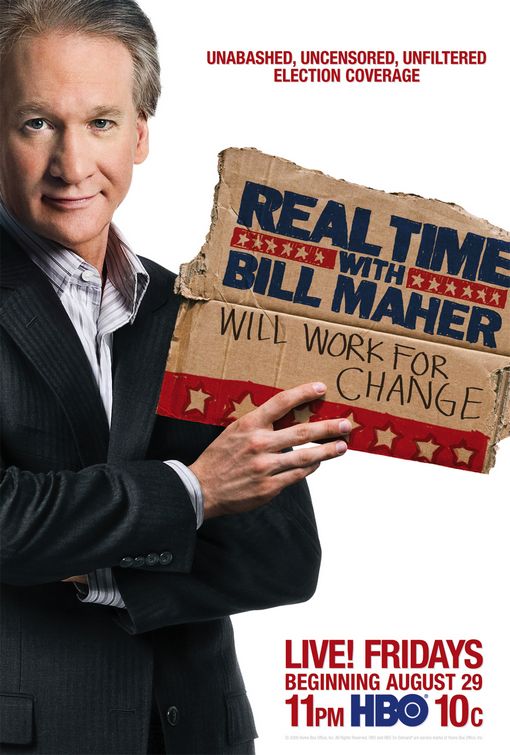
REAL TIME with Bill Maher (HBO 10pm Eastern) is going on break until September....but before going Bill left us with some New Rules regarding McDonalds, Katy Perry and Lady Gaga, the Former Half Term Governor of Alaska, and the oil industry.
Panelists include Oliver Stone, Bill Frist, Rachel Maddow,and Jon Meacham.
It was a memorable scene for fans of HBO's new series Treme, which takes place in New Orleans in the months after Hurricane Katrina devastated New Orleans and the Gulf Coast in 2005. Creighton Bernette (played by John Goodman) is a college professor/author and die-hard citizen of New Orleans who becomes frustrated at the pace of government and public response to the devastation of the city and life he loves. Creighton discovers that newfangled YouTube from his teenage daughter, and decides to air his grievances on all those who say New Orleans should be abandoned or left to implode on its own.
What follows is probably something many people in the region want to say about those who seek to minimize the impact the Deepwater Horizon spill on the Gulf Coast region, or to all those who choose to look the other way.
WARNING!!!!If you're easily offended, skip the video.
If the series survives for the next five years, perhaps Creighton should do a followup for 2010.
The stars of The Pacific; Jon Seda, Joe Mazzello, James Badge Dale
Episode 10 of The Pacific opens with Bob Leckie (James Badge Dale) in a Long Island hospital recovering from wounds incurred at Peleliu. A blond volunteer is reading to Leckie and another patient, ironically from Homer's The Odyssey, about the aftermath and long journey home of Odysseus from the Trojan War when the announcement is made of Japan's surrender....it was the long awaited VJ Day.
And from there we see where the journey went for the main characters of the series, plus several of the secondary players in the drama. The three central characters, Bob Leckie, Eugene Sledge (Joe Mazzello), and John Basilone (Jon Seda) had very different fates. Basilone was killed in action at Iwo Jima after seven months of marriage to Lena Riggi (Annie Parisse). Leckie was physically wounded and returned home even more cynical than he did when he left. But it was Eugene Sledge who experienced the most change in his wartime experience. Sledge left Mobile as a callow youth and returned a man who had seen and done horrible things in the act of surviving the war, and bore terrible internalized emotional scars not visible to others.
This episode had so many unforgettable scenes, such as the distance and coolness of Leckie's parents when he returned home in New Jersey. We understand Bob Leckie a little bit more after seeing his reunion with his Mom and Dad, who seem to be a couple of people who are not able to express love. Mr. and Mrs. Leckie used Bob's room as storage space, and greet Bob as if his homecoming was a kind of inconvenience. And it appears from the story that they probably didn't visit him while he was hospitalized- whether they knew he was on Long Island and chose not to visit him, or if Bob decided against informing them is unclear.
Bob's mother does appear to want Bob to have some happiness in his life. When he catches him spying on Vera Keller (Caroline Dhavernas) she suggests that Bob wear his Marine dress blues. Vera was dating a recent West Point grad, when Bob- in his dress blues- supplants the young officer in the life of Leckie's longtime neighbor. It seems that though the Leckies and the Kellers lived across the street from each other for twenty years that they were not in the least friendly. We see a certain amount of disfunction in Leckie's home life, and perhaps its the reason for his turning to writing; it became his expressive outlet. When we last see Bob Leckie in the series he and Vera are at a family dinner in the Leckie household. Family members are complaining about the inconvenience of the post war rail strike, and the then outrageous cost of one of those newfangled television sets. One male family member quips that they understand Bob's sacrifice during the war, but they clearly don't.....and they can't begin to comprehend the depth of that sacrifice. It is clear in the final scene with Leckie that he and Vera are in love, are a couple, and will spend their lives devoted to each other. Bob Leckie's Odyssey was over. He reclaimed his life and career, and found the love of his life in the process.
And further south in New Jersey, Lena Riggi Basilone visited the home of John's parents in Raritan. Three of the Basilone sons served in the war; John never came back. Lena received the news of John's death on Iwo Jima on her 32nd birthday. At first there seemed to be a certain distance between the two Mrs. Basilones. Mother Basilone had met her widowed daughter-in-law for the first time in the dorway of the Basilone home. Upon entering it becomes clear that this tight knit Italian-American family is still mourning the loss of their heroic son. The scene in which Lena hands John's Medal of Honor back to John's parents, and the tears that followed was one of the more poignant and heartbreaking minutes of television in many years.
The last third of the series concentrated on the experiences of Eugene Sledge; he became the central character as the series wound down, and Sledge was the one who took us through possibly the most horrific chapters of the Pacific war, if not all of World War II. Eugene became "Sledghammer" before our eyes; he went through the most profound changes, starting as a shy teenager in Episode One and returning home in the last chapter as a man who has learned to kill dispassionately because his life, and the life of his buddies, depended on it. And ultimately Eugene returns to Mobile damaged on the inside. Bob Leckie had a budding career in writing when he joined the Marines; his transition to civilian life went relatively smoothly compared to Eugene Sledge. Eugene had no career before the war, and no plans after it, except that he had seen enough of death and killing, and couldn't even bear to put on a uniform again after returning home. His friends Burgin (Martin McCann) and Snafu (Rami Malek) have some things lined up back in their homes in Texas and Louisiana, respectively (with an Australian bride on the way for Burgin). But Sledge is haunted by survivor's guilt; in a war where so many others in his unit had died or been wounded, and he came home without a scratch. And for this he cannot psychologically find a justification. While his brother Edward moved on after returning from Europe and got a job in a bank, Eugene seemed to mope and drift; what he needed was a release. That moment finally came when he went hunting with his father; Eugene Sledge couldn't bear to fire a gun to kill another living creature. He broke down and wept, as his compassionate father cradled his son.
We see Eugene in the series' final scene examining the delicate structure of a flower, sitting in the wonder of nature, perhaps finding that "eureka moment" when his calling finds him; he was to be a teacher of sciences, a distinguished professor and PHD, and he would become a gentle scholar that in later years no one would imagine was a combat veteran in the bloody Pacific theater.
Some Closing Thoughts
I'm glad that the creative team behind The Pacific gave the audience a chance to see what happened later in the lives of the characters. As of this writing only three of the main characters portrayed in the series are still alive; Sid Phillips, Chuck Tatum, and RV Burgin. Burgin and his bride Florence are still together after more than 60 years, and he maintains a website and does make personal appearances. He has also co-authored a memoir of his wartime experiences, Islands of the Damned.
Today I decided to cash in a Barnes and Noble gift card my niece gave me for my birthday. With the card I got Robert Leckie's Helmet For My Pillow and Eugene Sledge's With The Old Breed, two of the books in which The Pacific was based.
And one of the first things I looked for- prompted by many of the queries to this site- was for information about the mysterious "Stella". Bob Leckie's romantic interest in Melbourne.
Well folks, here's the news. There was no Stella.
The episode involving "Stella" was fictionalized but had basis in fact. Bob Leckie had a relationship with two women in Melbourne. On pages 146-152 of Helmet For My Pillow Leckie talks about a woman he called "Molly", and another "Sheila". It was his budding relationship with "Sheila" that caused his breakup with "Molly". Also, "Sheila" was a married woman, a fact that Leckie did not know until late in their romance.
So why change the facts in this part of the story when so many great pains had been taken for historic accuracy in the series?
Probably for a few reasons. But here's what I think. Bob Leckie was of that generation of our parents and grandparents in which you did not kiss and tell. In his book Leckie never assigned last names to the two women, and probably made up their first names as well. Possibly Bob took their true identities to his grave.
And maybe that's how it should have been.
So if Bob Leckie disguised the true facts and identities of his romances in Melbourne, it probably gave a green light to present that episode with a certain degree of artistic license. Perhaps "Stella's" Greek background came from a different source from another romance in Australia involving different players. But in the long run, it doesn't matter....the episode accomplished what it set out to do; that is, present the fragility of wartime romances in all of their heartbreaking detail.
Mission accomplished.
As for the two books, I've read the first chapter in each, and it brought back memories of my own basic training. "DI's" and "TI'S" must get a thesaurus of commonly used cliches to use on new recruits, because it doesn't matter what branch of the service you were in, or what year it was, you're guaranteed to hear the same in yer face profane language.
"Yer heart belongs to Jesus but yer ass belongs to me!"
As for the writing of the two memoirs, oddly enough I find Sledge's book to be more readable (so far), though Bob Leckie was the professional writer. Sledge's writing style was that of a teacher, trying to get you to learn something you didn't know. Bob Leckie, on the other hand, wrote his book like a storyteller; sometimes it takes awhile to adjust to his style.
I'm glad I bought both books, and I do intend to read each one. With Memorial Day around the corner, maybe I'll spend sometime during the day remembering those who fought and fell, and those who returned from the campaigns in the Pacific.
Update! Wednesday May 18
I'd never thought of checking out Alan Sepinwall's TV Blog about the accuracy (or lack) of Episode Three involving "Stella". In his blog you'll find more confirmation that the Leckie-Stella romance was fiction.
Sorry romantics out there! It was a great storyline just the same.
But here's an angle I thought of as well. Stella was of Greek extraction, and the hospital volunteer was reading Homer's The Odyssey to Leckie in Episode 10. Probably a metaphor for his wartime battles and serpentine route to returning home.
Whaddya think?
Update! Sunday, May 23
More than a few readers have logged unto this blog inquiring "who played Bob Leckie's mother?" on The Pacific. Well, she's a familiar name, face and voice for fans of 1970's TV, of Stephen King movie adaptations, and a legend of the Broadway stage. Marion Leckie was played by Betty Buckley. Ms. Buckley played Abby Bradford, stepmother to the Bradford clan in the 1970's TV series Eight Is Enough. She first came on the scene in 1976 as the sympathetic teacher Miss Collins in the original screen version of Carrie, and has made numerous movie and TV appearances in the years since.
But Buckley's biggest success has come on the Broadway stage, including roles in 1776, Pippin, and Sunset Boulevard. Her greatest role, and the one she will always be remembered for, was Grizabella in Cats.
This is the latest installment of my review of HBO"s THE PACIFIC, following the story of three US Marines and their comrades in that theater in World War Two
Episode Nine of The Pacific was probably the most difficult of any to watch, probably because the level of death and devastation to the civilian population of Okinawa during the 82 day siege in the spring and summer of 1945. About one third of the island's 490,000 natives were killed, some caught in the crossfire, some used as human shields by the Japanese, some conscripted into the Japanese army, which was going to defend the island to the last man; Japan had already reconciled that it could not hold Okinawa- they would try to kill as many Americans as they could before the anticipated invasion of the Japanese home islands.
One aspect of the invasion that the episode did not show was the mass suicide of scores of civilians who were told by the Japanese that the Americans would rape and torture them after capture. There were newsreel accounts from the island of mothers throwing their children from cliffs, and then jumping to their deaths.
There were 300,000 American troops in the invasion of Okinawa, both Marines and Army, and a flotilla of more than 1,500 ships. There were 110,000 defenders on Okinawa, including Okinawan conscripts. American losses in the battle, in both sea and air were around 72,300- that's the population of my hometown, plus two neighboring ones, combined.
In Episode 8 Sledge (Joe Mazzello), Snafu (Rami Malek), Burgin, and Leyden are joined by reinforcements Hamm and Kathy; its May 1945 in the siege of Okinawa. The First Marine Division is under constant fire, and there are heavy casualties; they're up to their necks in mud and muck, and there is frequent torrential rain. Vehicles can't get through to pick up the wounded or remove the dead; often corpses are left to rot. And at times when the Marines are told to "dig in" they come upon a freshly buried body, which they occupy just the same.
Sledge, once the the innocent inheritor of the gentility of the Old South's aristocracy, has morphed into a killing machine, one who thinks that the only way to ever beat Japan is to kill every last one of them. And that was one of the more chilling aspects of the episode- this fresh faced kid who we saw in Mobile in Episode One nearly loses his soul from the ambiguous morality of what a combatatant has to do in wartime.
In one firefight the Japanese use civilians as a human shield, and most are killed in the crossfire; Hamm is also among the dead. With each day the Marines start to descend closer to madness; Snafu and Sledge, who became friends since Peleliu, have to be separated before coming to blows. Sledge and Snafu come to a bombed out hut, where they find a crying baby next to its dead mother; they look at the infant with a robotic blankness; another Marine picks the baby up and admonishes the non- responsive duo with a "what's wrong with you guys?".
After Snafu leaves the hut, Sledge finds a badly wounded Okinawan woman lying on the floor of the hut, apparently dying. In the most harrowing and gut wrenching scene in a series full of them Sledge approaches her with his weapon aimed at her; the woman grabs the weapon and draws it to her head, motioning Sledge to kill her.
Sledge pauses for what seems like an eternity- and at that moment he finds a spark of moral redemption; he puts down his weapon, and cradles the dying woman in his arms until she passes on. Eugene Sledge was at the brink of losing any moral compass that he had, and at that moment he grabbed it back. He was still human, and had compassion for this poor dying soul caught in the crossfire. She was of a different race, that of his mortal enemy who he swore to kill, but was not of them. Sledge's father warned him of what he had seen in the First World War, the scores of men who lost their souls. Eugene Sledge would have lost his had he killed the woman. He was saved by his own humanity.
Sledge leaves the hut, and sees a young Japanese soldier trying to surrender. He allows him to live, but then the soldier is killed by a group of new Marines.
The last scene of the episode shows Okinawa secured. It is Augest, 1945. Their CO tells Sledge, Burgin, and Snafu that the Americans had dropped some new kind of bomb on a Japanese city, killing everyone. They didn't know it yet, but it was the end of the war in the Pacific, and the birth of a second war, a Cold War.
This episode underscores what many feel today, and felt back in 1945 when the decision to drop the atomic bomb first on Hiroshima and then Nagasaki was made; an invasion of the Japanese homeland would have probably resulted in a slaughter on a scale never before seen in human history. Allied casualties could have been a million or more, and that of the Japanese may have reached ten times that. As far as not invading Japan but surrounding the islands to "starve them into submission"- that would have resulted in even more widespread misery to the civilian population, and would have made Allied warships sitting ducks for kamikaze attacks.
All war is full of moral ambiguity on some level; and so was the decision to drop the atomic bomb. The unthinkable became the necessary, because any other way might have been at a cost too steep to pay.
To preface this commentary on the latest episode of HBO's The Pacific I'll recall a line from James Bradley's Flags of Our Fathers.....
"The Japanese were not on Iwo Jima. They were in Iwo Jima"
For me, Episode 8 of The Pacific was the saddest. I knew what was going to happen; anybody who had grown up in post World War II New Jersey could tell you the story of John Basilone, the hero of Guadalcanal who re-upped after winning the Congressional Medal of Honor and was a national celebrity, only to die on the first day of the assault on Iwo Jima in February, 1945. Basilone died the warrior's death, and became a legend. And Episode 8 of "The Pacific" fills in some more of the gaps of Basilone's life between Guadalcanal and Iwo Jima, including his romance and marriage to Marine Sgt Lena Riggi.
The episode begins on Pavuvu with Sledge (Joe Mazzello) and Snafu recovering from the hellish fighting on Peleliu, with Sledge increasingly agitated and embittered, a man who has aged beyond his years.
John Basilone (Jon Seda) was in New Jersey, visiting his family, becoming evermore annoyed at the celebrity thrust upon him. After trying again to return to the Corps he is finally granted his wish, and is reassigned to Camp Pendleton in California to train new troops, most of whom are learning the intricacies of machine gun warfare.
Basilone meets Sgt Lena Riggi (Annie Parisse, left) who he is attracted to. Lena rebuffs Basilone at first- she is unfazed by his celebrity, but John is persistent and continues to ask Lena out.
Eventually she warms to him...and he proposes to her, and Lena accepts.
Lena and John marry, and not long afterward John decides to re-enlist. He is sent to Iwo Jima. On February 19, 1945 the United States Marines landed on Iwo Jima, a 7.5 mile pile of volcanic rock and ash, the last major step before the Japanese home islands. The Japanese had built an intricate network of fortresses and tunnels on the island, and were ordered to fight until the last man; there would be no surrender from the Japanese defenders.
Basilone and his men hit the beach of Iwo Jima...he yells, screams, and curses his men to get off the beach and to advance before they are killed by Japanese fire. Basilone heroically leads the assault, but is cut down by enemy gunfire, and dies.
The final shot of the episode shows Lena Riggi Basilone in her uniform, staring out over the waves of the Pacific, knowing that out there was the place where the man she loved was taken from her. There is silence, and then the closing credits.
This episode was different from the ones preceding it in that it had to flashback more than a year to tell the story of the Riggi-Basilone romance and marriage. Once those gaps were filled the story of the Pacific war went back into sequence, with Iwo Jima following Peleliu.
For those interested about the battle of Iwo Jima, please check out the two films Clint Eastwood directed several years ago, Flags of Our Fathers and Letters From Iwo Jima. They are companion pieces, and tell the story of the battle from the perspective of both the Americans and the Japanese. If you are a fan of THE PACIFIC, these two movies are MUST sees.
Welcome to my review and comments about the latest episode of HBO"s THE PACIFIC. To those who may be reading this blog for the first time, my practice is to watch the episode on Sunday on its first airing, and watch it a second time a day or so later before commenting.
The United States Marine action at Peleliu in September and October, 1944 is one of the forgotten battles of World War II. It was originally conceived to protect General Douglas MacArthur's flank while the US Army continued its retaking of the Philippines from the Japanese invaders. The airstrip on Peleliu was supposedly of value in MacArthur's campaign. As it turned out, it was never a factor in those actions; the Marines fought, suffered, and died on Peleliu in a two month long battle for a spec of land in the Pacific that in the end had little strategic value.
Eugene Sledge (Joe Mazello) and most of the other Marines fighting on Peleiu reach their breaking point. The days were either excruciatingly hot or are a torrent of rain. One of the more memorable scenes of Episode Seven was when Captain Haldrane talked to Sledge and the other men during a heavy rain, when he tells Sledge that he can't "dwell on it"- the loss of life and the horror he sees everyday. And then "The Skipper" tells his men to get some sleep, while the rain pounds and soaks them.
Japanese soldiers are driven out of their fortifications by burning them alive with flame throwers. Marines are shot and blown to bits. The Japanese attack the Marines at all hours of the day, and especially at night when they generate near panic and terror. The battle goes on for weeks and months- the Marines are malnourished, exhausted, and near collapse. Some do snap mentally, and not only the young troops; the grizzled World War I veteran Gunny Haney is among those who succumbs to the sight of death and destruction he saw daily.
This episode dealt heavily with the moral ambiguity men in combat feel. After awhile the combatant starts to feel a certain loss of humanity, sometimes wishing for his own death to be quick and relatively painless, while dealing with death he has caused as a fighting man. Sledge starts to go over to a point of darkness; after the death of Captain Haldrane from a sniper's bullet, Eugene was sitting with Snafu, when Sledge decides to take the gold out of a dead Japanese soldier's teeth. Snafu, who has done the same on occasions, stops Sledge, telling him that the dead man has too many germs. In reality Snafu is telling his friend in a subtle way that he, Snafu, has crossed over to a darker place; he doesn't want Sledge to do the same.
In a moment of dark comic relief of sorts a Marine goes into a cave to relieve himself when he is attacked by a sword wielding Japanese; he chases the Marine, pants down, to the area where the rest of the Marines are. The Japanese soldier is shot and killed, but not until the poor young Marine makes a "deposit" in his own pants, to the amusement of the troops watching and laughing.
At the end of the episode the island is captured, and Sledge and the others are evacuated to Pavuvu. At Pavuvu the Marines are given orange juice by female Red Cross workers. Sledge and Snafu stop and get some juice, and the exhausted men pause to look at the beautiful young women pouring the refreshments. They are told to move on by a fresh looking first Marine officer in a clean pressed; the worn out Sledge turns and gives a cold stare to the officer who got the message- leave him alone, he and the others have lived through hell.
Joe Mazello did a subtle and convincing job in his portrayal of Eugene Sledge; the character seemed to age 10 years in the span of two. We first saw Sledge as a teenaged boy at home in Alabama. When we left him, as he was swimming naked in the ocean at the end of the episode, he was now a world weary veteran, forced to grow up hard and fast. He personified the story of tens of thousands who went off to war not far removed from childhood, and who returned as men.
On a small sidebar plot, we saw John Basilone (Jon Seda) on a bond tour in front of an organization that appeared to be Shriners, with actress Virginia Grey in tow. We later see Basilone at a driving range, flanked by dozens of reporters. Basilone started hitting bucket after bucket of golf balls, into the night, to a point where his hands started to blister and bleed. All the time Basilone is shown to have mental flashbacks to Guadalcanal, and to the the death of his buddy Manny Rodriguez.
Basilone's story will continue in Episode Eight, as the United States starts to zero in on the Japanese home islands.
But first they must take the last stepping stone, a small island within range of the Japanese homeland.
Peleliu is sometimes called "the forgotten battle" of World War II's Pacific theater. Guadalcanal, Iwo Jima, and Okinawa are part of our collective American historical psyche. But it was at the two months long battle from September to November, 1944 that the Japanese strategy had shifted from trying to overwhelm the Americans and the allies with "human wave" attacks to allowing them to land and then trying to inflict as many casualties as possible, even if it took the life of the last Imperial Japanese soldier.
With Part Six of The Pacific the character emphasis starts to shift away from Bob Leckie (James Badge Dale) and towards Eugene Sledge (Joe Mazello). The episode began in Mobile, Alabama. Its late at night in the aristocratic Sledge household, when a car pulled up- the butler told Mrs. Sledge that its a man in uniform. The dignified Southern lady's face instantly turned to one awaiting sorrow; she's sure that the man in uniform was coming there to tell her that her son had been killed in action.
All are relieved when the young Marine turned out to be Sid Phillips, who came for a visit. Sid told them that Eugene is in good hands with the First Marine Division- all are good men, and he thought Eugene would be in good company.
Eugene and his comrades were on Peleliu. After being fired on by artillery from the hillside, the Marines had to cross the airfield to get to higher ground. On the airfield hundreds of Japanese were waiting to cut them down. Water was scarce, and the temperatures exceeded 100 degrees. In a scene that resembled a kind of Holy Communion, Sledge, Snafu, Oswalt, and the other Marines shared what little water they have left by drinking from the same canteen before their run across the airfield....some of them would not get out of the situation alive.
The run across the airfield resulted in heavy casualties; among those killed was Oswalt. Leckie's pal Runner was seriously wounded. In order to save his buddy Leckie ran back across the airfield to find a corpsman and a radio. Leckie was knocked unconscious by a bomb blast. Hours later he awakens on a hospital ship (at the end of the episode he was reunited with Runner).
While spending the night in a secure area, Sledge admitted to Captain Haldane about how scared he was crossing the airfield. Haldane told the Sledge that the only Marines who weren't scared were either crazy or dead. Sledge had gained the trust of the combat veterans, including the battle hardened Snafu, who started calling Eugene "Sledgehammer". While approaching an entrenched Japanese mini-fortress, the Marines spend the night, trying to keep it quiet to avoid a Japanese bayonet attack while most of them are sleeping. One Marine started screaming and thrashing about, and wouldn't be quiet....in order to save the others a Marine hit the guy on the head with a shovel, a blow that kills him. Sledge rationalizes the next day that it had to be done...if the man wasn't silenced, all of them could have been killed.
Sledge and his comrades watched Captain Haldane ride off to attempt to get a change of orders; they didn't have sufficient numbers to overtake the Japanese stronghold, and an attack would have led to needless and unacceptable casualties.
On board the hospital ship we see Leckie and Runner, reunited and wounded, both sailing out of the South Pacific, and probably out of the war.
Notes
Once again for those who may be reading my comments for the first time, I always watch an episode of THE PACIFIC twice. On the second viewing I start to make notes on anything that stood out, and look for little things that I should have picked up on in the first look, but didn't.
John Basilone (Jon Seda) was no where to be found in Episode Six. But he will be back, probably in Episode Seven and almost certainly in Episode Eight.
And in closing....my Mom always told me that she had a cousin who died in the Pacific theater during World War II. I always thought he died at Iwo Jima, but that was wrong.
Mom told me he was with the Marines at Peilelu, and was killed by a sniper. So I had a cousin who died in combat in that little piece of hell, one who was killed years before I was born. I know he is buried somewhere in South Jersey.
I think I owe it to him to find out where.....and to pay him a visit this Memorial Day.
First, I'd like to apologize to the many readers who have been following my comments on HBO's The Pacific for the delay on this post- I'm just knee deep in spring cleanup, and a bit swamped right now. By far, The Pacific and its characters have been the most popular topic on this blog with the readership for weeks, and I thank you all for dropping by read my remarks and feelings about each chapter of this amazing series.
Chapter Five could be divided into three parts. The first was about John Basilone (Jon Seda), now involved in a war bond drive with Hollywood star Virginia Grey (Anna Torv).....and involved in a tryst in a hotel room as well. Was that an actual incident? I haven't found any evidence....but then again I didn't look very hard. But I'll tell you this- the producers of The Pacific went so far as to contact Robert Leckie's widow to get a picture of her wedding dress. When she gave them a black and white photo they asked her what color the dress was, demonstrating their commitment to accuracy. So if they say that Basilone and Virginia Grey (pictured left) were an item ever so briefly, that's good enough for me.
Basilone is a reluctant celebrity, but seems to be handling it well. His brother George comes to visit in the hotel lobby, and John tells George (now a Marine) in no uncertain terms- don't try to be a hero. Older brother John told George that he doesn't have to prove anything.
The second part of the story moves on to the rat and land crab infested island of Pavuvu where Eugene Sledge (Joe Mazello) joins the Fifth Regiment along with Oswalt and Leyden. The combat veterans they meet give the new guys a cold shoulder, and they end up bunking in another tent. Sledge meets up with old boyhood buddy Sid Phillips, who is about to rotate back to the United States. Also on the island is Bob Leckie(James Badge Dale), who in a theological discussion with Sledge tells of his doubts of the existence of God. Sledge asks Leckie what he believes in, Leckie answers "Ammunition".
Finally, the Marines are transported to Peleliu, and on September 15, 1944 they hit the beaches of the coral atoll which is heavily defended by Japanese. The Marines sustain heavy losses, and Sledge, in his first combat, experiences the horror of war for the first time. Among the casualties is Leckie's buddy Hoosier, who is badly wounded in the thigh. Peleliu has an airfield that must be taken from the enemy, and there are many more Japanese on the island than anticipated. Operations felt that the island could be taken in a couple of days; it took two months. Temperatures in the daytime regularly hit 110 degrees, and there was little potable water for drinking.
One of the more horrific scenes of the episode was when Snafu and Sledge begin to have some chow, and Snafu puts his can down and goes to a dead Japanese soldier a dozen yards away. Snafu then starts taking out the dead Japanese soldiers gold teeth with his knife.
The episode ends with the Marines contemplating the next day's action on Peleliu.
A couple of random notes.
When I first read that the Battle of Peleliu was going to be spread out over three episodes I thought..."You've got to be kidding".
But after seeing the episode twice, and reading up on the background of the action, it was entirely appropriate, and even necessary. Battles in the Pacific theater were unalike those in Europe and North Africa in that very often there was no retreat and no surrender, so the battles lasted weeks and months instead of days. By stretching Peleliu out over a two week three episode span the viewer gets a better sense of what these guys were up against.
And even though it was the second time I saw Episode Five, my heart was racing and thumping in the brilliant scene of the landing craft approaching the beach at Peleliu...I've seen many war movies over the years, but the recreation of the amphibious landing was brilliantly staged, and so realistic it was scary. Thank God it was not in 3D.
The chilly reception Sledge and his buddies got from the veterans was typical of what many experience in the service. I was on the receiving end during my tour, and I dished it out when I was one of the "old guys". Looking back on it now, it seems silly and cruel.....so if Airman Jones or Airman Babcock have dropped in and are reading this, I apologize for being such a boorish pain in the ass way back when.
The Tudors, my favorite "historical entertainment, returns tonight on SHOWTIME. Subtitled "the Final Seduction" we find Henry VIII (Jonathan Rhys Meyers, now middle aged and wed four times, enthralled with the beautiful teenager Katherine Howard (Tamzin Merchant). Though Henry has a daughter, Princess Mary (Sarah Bolger) who actually older than Katherine, he decides to marry her anyway. Henry overlooks his new queen's checkered past; and in doing so sets the stage for a virtual disaster for all those concerned.
One of the main criticisms of the show is its bending of certain historical facts for dramatic purposes....and its a legitimate argument. Michael Hirst, the creator and principle writer of the series has acknowledged taking degrees of dramatic license in his presentation. Hirst said he was being commissioned to put together an entertainment, and that's what he did.
The Tudors is not unlike films such as Martin Scorsese's Goodfellas or Casino, where real historical events are presented with fictional characters based on actual people, and some fictionalized events are interspersed as well. For instance, we know that Henry's sister didn't actually marry (and murder) the King of Portugal, but a sister did really marry Charles Brandon (Henry Cavill)....though they really did have a child before Mary's (Margaret in the series) death, she died childless on THE TUDORS.
It is an odd that The Tudors, which will bend the story to make it better, and The Pacific, which strives for detailed accuracy, are broadcast opposite each other in the United States, on SHOWTME and HBO, respectively. Both series are reasons for watching TV (in my eyes anyway), and they'll hold my interest into summer, where I await the return of my favorite, Madmen.
But most importantly, they serve as a diversion from the world of politics...on this blog, anyway. And the way things are going, I consider any scripted series worth watching in the age of unreality reality TV to be a lifesaver.
James Badge Dale as Robert Leckie in HBO's "The Pacific"
So the boss yelled at you at work, your kid is screaming for a new cell phone, your wife is still ticked off about the cheap anniversary present you got her, and its April 8 and you haven't done your taxes.
And you think you've had a bad day?
The fourth episode of The Pacific will put it all into perspective for you.
It opens with Eugene Sledge (Joe Mazello) in training as part of a Marine mortar team in December, 1943, and shifts to a troop transport with Robert Leckie (James Badge Dale) on its way to Cape Gloucester, New Britain to seize the island for its airstrip from the Japanese occupiers. This episode answered a question I always had about the men in the Pacific theater; how did they find the courage to keep on island hopping again, and again, and again. They had multiple D-Days, and when they landed in the Pacific they had two enemies- the Japanese and the savage tropical environment.
The answer to that question is that some just men just weren't emotionally capable to return to the hellish fighting and situation they were in. On New Britain the Marines wore the same clothes for months at a time, with mud up to their knees and an enemy trying to kill them in attacks that could happen at anytime. In this episode we saw fighting men descend into madness, with one Marine slowly manually strangling a wounded Japanese soldier and smiling about it, and another Marine taking his uniform off and blowing his brains out. At one point in a torrential storm Leckie cries out for someone to shoot him to end his misery.
Leckie contracts enuresis and his buddy "Runner" catches malaria. When both are shipped to the island of Pavuvu Runner asks Leckie to read his letters home to Vera. Leckie ends up in a hospital for his illness, but is sent to a psych ward because the regular hospital is overflowing. He questions his own sanity being in such a place after all he has endured, and sees some of the emotional damage done to other patients, among them his old platoon mate Gibson. Dr. Grant, a physician and psychiatrist, eventually gains Leckie's confidence. After a few days in the hospital Leckie decides he needs to return to his friends....he "bribes" Grant to sign his release papers by giving him a Japanese pistol he acquired in New Britain.
The final scene shows Bob Leckie leaving the relative normalcy of the hospital and the area behind the lines to join his company as they prepare for the bloody assault of Peleliu.
Some may see this episode as one where little happened....but I think this was an important bridge to the middle of the story, when in the summer of 1944 the Americans began a chain of successes on their way to the Japanese home islands, but with heavy costs. And as bad as Guadalcanal and Cape Gloucester was, its going to get much, much worse as these Marines move on to Peleliu, then Iwo Jima, and finally Okinawa. The hostile environment is a constant, but the ferocity of the Japanese defense will be amped up to a level no American fighting man had ever seen before or since. And that's why this episode was as important as it was....the Bob Leckies might have been wounded, ill, or both but they managed to get back and do it again. This episode gave a glimpse of the stuff these children of the Great Depression were made out of, a toughness and resolve that just may have served them in that theater. But that is not to say there weren't heavy casualties, not just dead or wounded physically, but those scarred emotionally. There probably lots of Gibsons and "Captain Midnights" who were never truly able to cope again, during and after the war.
Like Dr, Grant said in the episode, his job was not to cure, but to access....and move on.
Thanks for waiting for this latest installment, several days late....I'll try to be more current with the posts now that my life is back in a more normal rhythm again.
After a delay of several days, its time for my overdue take on this Sunday's episode of HBO's The Pacific. I did get a bit sidetracked by all the other news going on, and I wanted to get a chance to see the the second episode one more time. Though it deals with a period of only a few days of the Battle of Guadalcanal, I wanted to see it again to get a better feel for just what the Marines of the First Division were up against at Guadalcanal. A second viewing helps to grasp the enormity of the task at hand, what they did, and of the heroism of the First.
By October, 1942 the US Marines at Guadalcanal were cut off- the Navy had to move out after being repelled by a Japanese attack. They were alone, short of food and ammunition, suffering from the brutal tropical heat and humidity, insects, malaria and digestive tract infections- and were being harassed by Japanese attacks around the clock. After Robert Leckie (James Badge Dale) and his fellow Marines survive a Japanese assault, John Basilone (Jon Seda) and his men are sent by LT.Col.Chesty Puller to defend the perimeter around Henderson Field to keep it from falling back into Japanese hands. They are also ordered, if they are defeated, to go into the jungle and continue to fight as guerrillas, if need be.
On the night of October 24-25, 1942. Basilone and his men of C Company were vastly outnumbered, yet held their positions and repelled the Japanese attack. Basilone manned machine guns in the attacks, then repaired jammed guns, and went back through the jungle to get more ammo. He killed several Japanese in hand to hand combat and with his side arm, and returned to his men. One of his hands was badly burned when he touched the hot barrel of the Machine gun, but he fought on.
Below, his his citation, from the Arlington National Cemetery Website.
For extraordinary heroism and conspicuous gallantry in action against enemy Japanese forces, above and beyond the call of duty, while serving with the 1st Battalion, 7th Marines, 1st Marine Division in the Lunga Area. Guadalcanal, Solomon Islands, on 24 and 25 October 1942. While the enemy was hammering at the Marines' defensive positions, Sgt. Basilone, in charge of 2 sections of heavy machineguns, fought valiantly to check the savage and determined assault. In a fierce frontal attack with the Japanese blasting his guns with grenades and mortar fire, one of Sgt. Basilone's sections, with its guncrews, was put out of action, leaving only 2 men able to carry on. Moving an extra gun into position, he placed it in action, then, under continual fire, repaired another and personally manned it, gallantly holding his line until replacements arrived. A little later, with ammunition critically low and the supply lines cut off, Sgt. Basilone, at great risk of his life and in the face of continued enemy attack, battled his way through hostile lines with urgently needed shells for his gunners, thereby contributing in large measure to the virtual annihilation of a Japanese regiment. His great personal valor and courageous initiative were in keeping with the highest traditions of the U.S. Naval Service.
One source claims that Basilone killed 38 Japanese in that battle, another says the number was close to 100. While watching this sequence I noticed the battle, which lasted all night, was condensed into roughly eight minutes. Still, the portrayal of Basilone's action was accurate given the constraints of time. The next morning Basilone is told by Puller that he would be putting Basilone in for a medal. Basilone goes looking for his friend Manny Rodriguez, who stayed behind as a runner for Puller. Manny's body is found, laying dead in the jungle by Basilone.
Meanwhile back in Alabama, young Eugene Sledge( Joe Mazello) is told by his physician father that he no longer has a heart murmur. Gene tells his father that he will be enlisting, though his father has concerns about what war will do to his son.
By January 1943 the Japanese evacuate Guadalcanal, and some of the Marines are transported off of the island. The episode ends with Leckie and his friends finding out while drinking coffee in the galley of the transport that the Marines of the First Division at Guadalcanal were considered heroes back in the United States.
This morning while reading the print edition of The Star-Ledger I checked out letters to TV critic Alan Sepinwall, and one talked about the scope of The Pacific, and how it neglected the role the Army played in the theater. And it is a valid criticism- the series won't deal with the war in New Guinea or the Philippines, or in China, Burma, or many of the other fronts. Nor will it talk about the role of the Army Air Corps, and the Naval aviators or naval battles- the scope of the Pacific war was just too enormous and cost prohibitive to reproduce in a limited TV series. Much like Band of Brothers concentrated on one group in a series of battles in the European war, it was not the whole story of victory in Europe. "Brothers" didn't deal with the campaigns in North Africa or Italy, and of course, the first turning point in Europe was the German defeat in the Eastern Front by the Soviets.
And The Pacific does limit its story to the three main characters, Basilone, Leckie, and Sledge, and the war waged by Marines island hopping in tiny specs in the ocean, all the way to the Japanese home islands. What this series does is open the door to people who were too young to feel the direct impact of the war, and gives them a start in a search for the history of the war in the Pacific, in all its vast scope, tragedy, and triumph. For a more comprehensive view of World War II, I suggest Ken Burns' The War, shown on PBS several years ago and available on DVD.
Episode Three is coming up Sunday night, with Basilone getting the Congressional Medal of Honor and national celebrity status.
"We've elected a wise calm man who wants to get things done"....actor Tom Hanks on President Barack Obama.
"You are America's history teacher".....Mike Barnicle on Tom Hanks.
Actor, director, producer, activist, and historian; Tom Hanks is a man who wears a lot of hats. On the Friday (March 5th) edition of MSNBC's MORNING JOE Hanks joined hosts Joe Scarborough and Mika Brzezinski, along with guest panelists Tom Brokaw and Mike Barnicle, on a discussion about his latest project; The Pacific, premiering March 14th on HBO.
As with Band of Brothers and John Adams, Hanks serves as a co-executive producer (along with Steven Spielberg and Gary Goetzman)on this ten part mini-series about the United States in the Pacific theater of World War II. Hanks, on the cover of the latest TIME magazine, has become "America's History Teacher" with his entertaining and in depth looks at subjects and people who often get minimal coverage in the textbooks found in America's schools.
The discussion moved on to today's political world, the lack of anything getting done in Congress....and the pride of some Congressional members in that fact...and of the first year of the presidency of Barack Obama.
Interesting stuff which was wisely extended over two segments.
I often thought that the fighting men in the Pacific during World War II unfortunately took a back seat in our collective memory to those who fought against Hitler's Germany. As brought out in the discussion on MORNING JOE at least in Europe there was (to some degree) regard for military rules of engagement.....in the Pacific, there was none. In the Pacific race was a core of the fight, on both the Japanese and Allied sides, and often there was no surrender, only the slaughter of all who lost.
And as dramatic, traumatic, and heroic as the Normandy Invasion was for the Allies on June 6, 1944 I can't help but think of America's soldiers and Marines who had to engage in amphibious landings again and again and again while spending nearly four years of "island hopping" as they fought their way to the Japanese homeland.
They were some special, incredible, and brave Americans.....patriots who went home after it was over and back to their lives.
Everyone one of us alive today is in their debt.
And while The History Channel continues to morph evermore to a shlockey history-reality show hybrid, Hanks and HBO continue to come up with compelling historical dramas....and I salute them for doing so.
I'm looking forward very much to the premiere of The Pacific.