Showing posts with label infringement. Show all posts

Monday, May 16, 2011

Bridgestone v Bull - prior design defence in China

Many of our readers have questions about the enforceability of designs in China.  We are delighted to bring you this report of a recent case on tyres, courtesy of the eminent Mr Chixue Wei of Linda Liu Group in Beijing, which was recently published in their IP Newsletter No 9. 


Bridgestone Corporation v Zhejiang Hang Ting Dun Bull Rubber Co., Ltd. and Beijing Bang Li Xin Tire Co., Ltd.

Basic Information

The patentee
(plaintiff in the first instance, appellant in the second instance, applicant in the retrial procedure): Bridgestone Corporation (hereafter referred to as Bridgestone Company)

The accused infringers

(defendant in the first instance, appellee in the second instance, respondent in the retrial procedure): Hang Ting Dun Bull Rubber Co., Ltd. of Zhejiang Province (hereafter referred to as Bull Company); Beijing Bang Li Xin Tire Co., Ltd.

Competent Courts and Case No.
The first instance: Beijing No. 2 Intermediate People’s Court of P.R.C. (2007) No.2 Intermediate Court Civil First Instance No.391

The second instance: Beijing Higher People’s Court of P.R.C. (2007) Higher Court Civil Final No.1552

The retrial: The Supreme People’s Court (2010) Civil Arraignment No.189

Type of the Case:
Infringement on the Patent for Design

Final Decision:
Bridgestone Company won the litigation

Date of Judgment:

March 1, 2011
Course of Events
Bridgestone Company enjoyed a patent right for design over their tire (hereinafter referred to as the Design). In 2006, Bridgestone Company found that a tire manufactured by Bull Company was exactly the same as the Design, and therefore started infringement litigation over the patent for design with the Beijing No. 2 Intermediate People’s Court of P.R.C.
During the litigation, Bull Company presented a prior design defense. After the hearing, the court of first instance held that the prior design defense was tenable and did not constitute an infringement on the patent for design. Therefore, the court overruled the claims put forward by Bridgestone Company.

Bridgestone Company was dissatisfied with the judgment of first instance and appealed to the Beijing Higher People’s Court of P.R.C. The Higher Court affirmed the original judgment after a hearing.

Bridgestone Company was dissatisfied with the judgment of second instance and filed an application for retrial with the Supreme People’s Court. Through the hearing, the Supreme People’s Court held that the original judgment was wrong in application of the law and retried the case.
After the hearing, the Supreme People’s Court issued a final judgment that reversed the judgments of the first and second instance and decided that the defendant in the first instance shall cease the production and sale of the infringing tire. The court also required Bull Company to destroy the model and stock of the tire and reclaim the stocks from the distributors and destroy them, and pay for damages to Bridgestone Company.

Disputed Issues
1. The method of examination and judgment of the prior design defense in the determination of an infringement of the patent for design.

2. Whether the accused infringing product falls into the protection scope of the Design.

3. Burden of the civil liability of infringement.

Judgment of the Courts
Court of first instance
(1) The defendant presented its prior design defense and provided evidence of prior design. When applying a prior design defense, only the accused infringing product needs to be compared with the prior design to decide whether they are identical or similar.

(2) Although the accused infringing product constituted a similar design to the Design, it also constituted a similar design with the prior design when comparing them as a whole.

Therefore, the prior design defense claimed by the defendant is tenable, and accordingly, it does not constitute an infringement on the patent for design.

Court of second instance
When judging whether the design is identical or similar, the decision should be based on the knowledge and cognitive ability of average consumers. Comparing the accused infringing product with the prior design, it can be found that they are similar as a whole. The difference insisted by Bridgestone Company was not a significant impact on the overall visual effects. Consequently, the accused infringing product and the prior design constituted only a similar design.

Therefore, Bridgestone Company’s grounds of appeal are untenable.

Court of retrial
(1) When judging whether the prior design defense of the accused infringer is tenable, the accused infringing product should be compared with the prior design first to confirm whether they are identical or have no substantial differences. If the accused infringing product is identical with the prior design, the prior design defense would be tenable. If not, it should be further decided whether they have substantial differences or constitute similarity. When judging the similarity, if there is only a simple comparison between the accused infringing product and the prior design, the difference between them and the effects on both of the overall visual effects from the difference may be ignored. This may lead to a wrong judgment and lead to a situation where the design of the accused infringing product, prior design and the Design all constitute similarity. Therefore, when the accused infringing product is different from the prior design, in order to draw a correct judgment conclusion on the infringement of patent for design the prior design should be used as the base, and then a separate comparison conducted among the accused infringing product, the prior design and the patent for design and to make a comprehensive judgment. During this process, attention should not only be paid to the difference and the similarity between the design of the accused infringing product, the prior design and the impact on the overall visual effects, but also the difference between the Design, the prior design and the impact on the overall visual effects. Whether the design of the accused infringing product makes use of the difference between the design patent and the prior design should also be taken into consideration when judging whether there is a substantial difference between the design of the accused infringing product and the prior design.

(2) In this case, the accused infringing product is not identical with the prior design. In terms of the difference among the accused infringing product, the Design and the prior design, the difference between the Design and the prior design brings conspicuous impact on the overall visual effects. As the accused infringing product makes use of the above difference, the above difference also constituted the difference between the accused infringing product and the prior design. Compared with the similarity between the accused infringing product and the prior design, this similarity brings a more conspicuous impact on both of their overall visual effects. From the perspective of average consumers, the accused infringing product is not identical with the prior design, and they bear no substantial similarity on the overall visual effects.

Therefore, the prior design defense was not tenable, and accordingly the accused infringing product constitutes an infringement on the patent for design.

Our Comment
Although the prior design defense was stipulated expressly for the first time after the third amendment of the Patent Law of the P.R.C, there have been precedents recognized earlier in the judicial practice. However, as there are no explicit provisions on its principle of application and method of judgment, the way of handling the cases by each court vary accordingly.
As for infringement litigation over patents for design, when the defendant presents a prior design defense, the viewpoints of the courts of first instance and second instance are that it only needs to compare the accused infringing product with the prior design, and it compares the accused infringing product and the Design only when the accused infringing product and the prior design are not identical and similar.

With respect to the above viewpoint of the court, we are of the opinion that it lacks legal basis and is not in accordance with the purpose of the legislation. Thus, as the agent of Bridgestone Company, we filed an application for retrial and the Supreme People’s Court retried this case.

 From the written judgment of the Supreme People's Court, we can see that the Supreme People's Court expressly denied the method that only compares the accused infringing product with the prior design and then decides whether the prior design defense is tenable or not when the accused infringing product is not identical with the prior design. The Supreme People's Court held that infringement should be judged according to the following steps when the accused infringer presents a prior design defense in the infringement litigation of the patent for design:

Step 1:  Compare the prior design with the accused infringing product. If they are identical, the prior design defense is tenable and accordingly the infringement is not tenable.
Step2: If they are not identical, the prior design should be used as the coordinate, and then a separate comparison conducted among the prior design, the accused infringing product and the Design. The comparison should also be based on whether the accused infringing product makes use of the difference between the Design and the prior design as well as its impact on the overall visual effects so as to decide whether the accused infringing product is similar to the prior design and the Design.
It can be seen that the reasoning of the Supreme People’s Court took into full consideration the comparison of the Design and the prior design so as to seek a balance between the benefit to the patent holder of the patent for design and that of the public. This method is in accordance with the purpose of the legislation for the design and the prior design defense. Therefore, the Supreme People's Court has made a fair judgment in this case. However, as this method requests a separate comparison among the three designs and needs a comprehensive consideration of the impacts on the visual effects brought by the differences and similarities, it has a high requirement for a judge’s ability. We expect that the local courts can apply the prior design defense correctly in future judicial practice.

Author: Wei Chixue Law Firm

Tuesday, December 7, 2010

Judgment of Similarity of Designs in China


We have a treat for readers interested in China - a thoughtful article by Mr Liqiang Chang of Linda Liu & Partners discussing assessment of similarity in China with reference to two cases, reprinted with their kind permission from their IP NEWS issue 44 December 2010. The discussion has obvious resonances of the recent US debate on "point of novelty" versus "overall impression" assessments. Enjoy!


Judgment of Similarity of Designs under the Background of New Judicial Interpretation

Article 11 of the Interpretation of the Supreme People's Court on Several Issues concerning the Application of Law in the Trial of Patent Infringement Dispute Cases (Judicial Interpretation 21 (2009)) (hereinafter referred to as Judicial Interpretation) which came into force January 1, 2010 provides:
Article 11. When judging whether designs are identical or similar, the people’s court should conduct comprehensive judgment based on the design features of the patent design and the design accused of patent infringement as well as the overall visual effect of the designs; and consideration shall not be given to design features that are determined mainly by technical functions or features, such as the material and internal structure of a product, which do not influence the overall visual effect of a product.
In the following circumstances, the overall visual effect of a design is usually affected to a greater extent:
(a) the parts of a product, which can be seen easily when the product is used normally, have a more notable influence on the overall visual effect than the other parts of the product;
(b) the design features distinguishing a patent design from a prior design have a more notable influence on the overall visual effect than the other design features of the patent design.

Where a design accused of patent infringement is not different from a patent design in terms of the overall visual effect, the people’s court should ascertain that the two designs are identical; where a design accused of patent infringement is not substantively different from a patent design in terms of the overall visual effect, they should be ascertained as similar.
As shown above, the Supreme People's Court sticks to the previous principle, “whole observation and comprehensive judgment,” to judge similarity of designs. The Judicial Interpretation also introduces to this principle some new ideas which are embodied by the following point: it is prescribed that design features distinguishing a patent design from a prior design have a greater impact on the overall visual effect of the design than other design features of the patent design. Many applicants and patent agents have the following questions about the approaches for judging similarity of designs as provided by Article 11 of the Judicial Interpretation: Can we judge similarities between a design accused of patent infringement and a patent design only based on whether or not the accused design has the design feature which distinguishes the patent design from a prior design? Whether the courts should introduce a prior design ex officio or if it should be presented by the concerned party as evidence? How to reflect the principle of “whole observation and comprehensive judgment”? Now, the writer will give his opinions on the above questions.
For quite a long time, there has been a dispute in the field of design practice over the approaches of judging similarity of designs. The issue is whether or not we should compare the major parts of designs, or the inventive features of a patent design or the features of a patent design which distinguish it from a prior design? This dispute was reflected for the first time in the “judgment by comparing notable parts” approach established in the Guidelines for Patent Examination of 2001. In 2002, in a case about the validity of a design patent of a storage compartment at the tail of a motorcycle, the above dispute led to a result in which the court and the Reexamination Board came to completely contrary conclusions. Because such a dispute caused uncertainty in the application of law, the concept “notable part” was abolished and the principle “whole observation and comprehensive judgment” was established in the Guidelines for Patent Examination of 2006. The principle “whole observation and comprehensive judgment” has been followed until now and is universally acknowledged by members of the design practice field including the courts and the Reexamination Board.
However, we also noticed that there still exists a perspective that similarity of designs should be judged based on the inventive features of a patent design or features of a patent design which distinguish it from a prior design. For example, Article 12 of the Interpretation of the Supreme People's Court on Several Issues concerning the Application of Law in the Trial of Patent Infringement Dispute Cases (versions for comments) provides:
Article 12. When judging whether designs are identical or similar, the people’s court should comprehensively consider all the design features within the protection scope of the design patent. However, consideration shall not be given to the sole design feature which has to be adopted for realizing the technical function of a product or features, such as the material and internal structure of a product, which do not influence the overall visual effect of a product.
Where the relevant public may confuse a design accused of patent infringement with a patent design in terms of the overall visual effect, the people’s court shall consider the design accused of patent infringement and the patent design to be similar. Where a design accused of patent infringement does not have the essential features of a patent design, it shall be considered that the design accused of patent infringement and the patent design will not confuse the relevant public in terms of the overall visual effect.


The above-mentioned essential features refers to design features with which a patent design, as compared with a prior design, can have a notable visual effect on the relevant public. The people’s court may identify the essential features of a design by referring to the brief explanation of the design.
According to the above provision, if a design accused of patent infringement does not have the essential features of a patent design, then it will not cause the relevant public to confuse the two designs in terms of the whole visual effect; that is, they are not similar. In other words, during the judgment process, there is no need to determine the effect other design features have on the whole visual effect if they are not essential features. Such an opinion is contradictory to the generally acknowledged principle of “whole observation, observation and comprehensive judgment.” Therefore, the above Article 12 was deleted in the final version of the Judicial Interpretation officially published at the end of December 2009 and Article 11 of the Judicial Interpretation introduced the principle of “whole observation, observation and comprehensive judgment” which incorporates the aforementioned new ideas.
As it can be seen from the Supreme People’s Court’s amendments to Article 12 of the Judicial Interpretation (version for comments), similarities between a design accused of patent infringement and a patent design cannot be determined only based on whether or not the design accused of patent infringement has the design features of the patent design which distinguish it from a prior art. Generally speaking, the inventive parts of a design, i.e., the design features of a patent design which distinguish it from a prior design, have greater influence on the whole visual effect of the design, so they deserve more attention. However, the basic standard for judging whether designs are identical or similar is the whole visual effect. That is to say, we cannot consider a design accused of patent infringement and a patent design to be similar or dissimilar only on the grounds that the accused design has or has not the features of the inventive parts. The final judgment should be made based on whether the two designs are different in the whole visual effect.
The courts have decided several cases since the new Judicial Interpretation was implemented. Although the courts followed the previous patent law when trying the cases because the patent infringements involved took place before the new patent law took effect, we can still get a hint of a trend in applying the approaches for judging similarity of designs, which were established in the new Judicial Interpretation, to the trial of patent infringement dispute cases. The writer will make an analysis with the following two typical cases.

Case 1: Design patent infringement dispute appeal case—Fu’an Bojie Electrical Machinery Co., Ltd V. Shanghai Rongtai Fitness Tech. Development Co., Ltd, No. 177 (2009)

Final Judgment of IP Tribunal of Zhejiang Higher People's Court


A brief introduction to the case: the plaintiff, Shanghai Rongtai Fitness Tech. Development Co., Ltd (hereinafter referred to as the plaintiff), filed a patent application for the design of a “massage chair (deluxe)” on December 29, 2006 and was granted a patent right on January 09, 2008. However, when the patent right was still valid, the plaintiff found that the deluxe multifunctional massage chair (hereinafter referred to as the accused product) manufactured by the defendant Fu’an Bojie Electrical Machinery Co., Ltd (hereinafter referred to as the defendant) had infringed the above patent right of the plaintiff, and the plaintiff filed a law suit against the defendant. During the trial of the case, the defendant, on the basis of a prior design 1, filed a request to the Reexamination Board of the SIPO (hereinafter referred to as the Reexamination Board), requesting the Reexamination Board to declare the concerned patent invalid. After examination, the Reexamination Board made a decision that the patent right remained valid. After trying the case, the First-Instance Court ruled that the defendant’s infringement of the patent right was a fact. The Second-Instance court upheld the original judgment.


Focus of dispute in this case: How did the inventive part of the patent concerned influence the judgment of similarity?


In its decision No. 13126 that the patent right remained valid, the Reexamination Board held that a normal consumer distinguishes one massage chair from another mainly from the unconventional designs, which are different from the designs of a common chair. Except for the conventional designs, the patent concerned and the prior design were different in the shape of the two sideboards and the differences had a notable impact on the overall visual effect, so the validity of the concerned patent was maintained.
The Court of Final Appeal held that the notable differences between the concerned patent and the prior design constituted the inventive part of the patent. On the basis of the statements of the concerned parties in the invalidation procedure and the decision of the Reexamination Board, the Court of Final Appeal held that the inventive part of the patent should be the appearance of the sideboards. After comparing the design features of the product accused of infringement and the concerned patent, the Court of Final Appeal concluded in its written judgment that “the overall appearance of the product accused of infringement, especially the appearance of its sideboards, is not notably different from the patent design in terms of visual effect and it is easy for a normal consumer to mistake the product accused of infringement for the patent design, so the two designs are similar and the product accused of infringement falls into the protection scope of the concerned patent .”


As can be seen from this case:
1. The feature of an inventive part is an important factor which has an impact on the overall visual effect, but the fundamental criterion for judging whether designs are identical or similar is the overall visual effect (“the overall appearance of the product accused of infringement, especially the appearance of its sideboards, is not notably different from the patent design in terms of the visual effect”).
2. When comparing the similarity between a patent design and a design accused of infringement, if the concerned party puts forward a prior design, then the features different from the prior deign should be identified and determined on the basis of producing evidence and a cross-examination by the concerned parties. Generally, the courts do not directly introduce prior designs or request the party concerned to provide a prior art.


Case 2: Foshan Shunde Xinshengyuan Electrical Appliances Co., Ltd. sues Shanghai Meixin Plastics Co., Ltd. for design patent infringement, No. 285 (2007)

First-Instance Judgment of Shanghai No.1 Intermediate People’s Court No. 5 Civil Tribunal (IP Tribunal)


A brief introduction to the case: The plaintiff, Foshan Shunde Xinshengyuan Electrical Appliances Co., Ltd. (hereinafter referred to as the plaintiff), enjoyed the design patent right of a product called “blower.” The plaintiff found that the defendant, Shanghai Meixin Plastics Co., Ltd. (hereinafter referred to as the defendant), manufactured a blower with the same appearance as that of the patent product of the plaintiff when the patent was still valid, so the plaintiff filed a lawsuit. During the trial of the case, the defendant filed a request to the Reexamination Board of the SIPO (hereinafter referred to as the Reexamination Board), requesting the Reexamination Board to declare the patent invalid. After examination, the Reexamination Board made a decision that the patent right remained valid. The court held that the product accused of infringement was similar to the plaintiff’s patent product as shown in the picture in terms of the overall visual effect, so it fell into the protection scope of the design patent right held by the plaintiff.


Focus of dispute in this case: if a product accused of infringement did not have the features as described in the brief explanation of the concerned patent, is it definite that the accused product did not constitute an infringement?


In this case, the plaintiff described in the brief explanation of the concerned patent “a shell of the product incorporating the present design is made of a transparent material.” The product accused of infringement was made of a non-transparent material, so the defendant argued that the accused product was not similar to the patent concerned. When judging the similarity between the two designs, the court made a comparison of the essential features shown in the picture of the patent and concluded that the essential features of the accused product’s design were similar to those of the plaintiff’s design. As for the defendant’s affirmation that the feature of “a shell of the product incorporating the present design is made of a transparent material” as described in the brief explanation of the concerned patent notably influenced the overall visual effect of the product, the court held that the brief explanation is a concise description of the essential features of the design, the omitted views, and the colors for which protection is sought. By comprehensively considering the similarity of the essential features of the two designs, it could be determined that the description in the brief explanation did not influence the judgment that the accused product was similar to the plaintiff’s patent product as shown in the picture in terms of the overall visual effect, even though the plaintiff descried in the brief explanation of the concerned patent that “a shell of the product incorporating the present design is made of a transparent material.”


As can be seen from this case:
Although the product accused of infringement does not have the features described in the brief explanation of the concerned patent, it may still constitute an infringement of the patent concerned. The key to making a judgment is whether or not the overall visual effect will be rendered different if the accused product does not have the features described in the brief explanation.


Concluding Remarks

The foregoing are the writer’s opinions on some controversial issues about the judgment of similarity of designs under the background of the new Judicial Interpretation. With the above analysis, the writer hopes to help applicants better understand the principles of judging similarity of designs. Since China does not apply Case Law, the above-mentioned two cases are for reference only. We hope that the judicial department can further clarify the specific comparison principles for the judgment of design patent infringements in the Judicial Interpretation so that patentees and the public can have a more reasonable and clearer expectation about the exercise of a design patent right.

Thursday, August 5, 2010

Dyson v Vax: full judgment now available

The judgment of Mr Justice Arnold in Dyson Ltd v Vax Ltd [2010] EWHC 1923 (Pat), discussed here earlier this week on Class 99, has now been made available on the BAILII database. You can read the 95-paragraph judgment and view the appended design illustrations here.

Right: Vax's Mach Zen vacuum cleaner -- definitely not a Dyson ...

Tuesday, August 3, 2010

Dyson doesn't clean up after all

Dyson Ltd v Vax Ltd [2010] EWHC 1923 (Pat), a Patents Court for England and Wales decision of Mr Justice Arnold last Friday, 29 July, is not yet available on BAILII. It was however noted by a very useful LexisNexis alert. It's another major piece of IP analysis in Mr Justice Arnold's tour of key areas of IP but, for a change, has not resulted in the reference of a batch of questions for preliminary ruling by the Court of Appeal of the European Union.

Right: now here's a dust-removal device that looks as if it's safe from Dyson's design registration

Dyson originated the two-stage cyclone dust-separation technology for vacuum cleaners, this being an alternative to the use of porous bags. In December 1994 Dyson applied for a UK registered design under the old Registered Designs Act 1949. This design, for a 'vacuum cleaner', contained the following statement of novelty under rule 15(1) of the then-current Registered Designs Rules 1989, SI 1989/1105:
"The features of the design for which novelty is claimed reside in the shape and configuration applied to the article...".
This application pre-dated Design Directive 98/71, which provided:
"A design right shall not subsist in features of appearance of a product which are solely dictated by its technical function...".
The Directive was incorporated into domestic law by amending the 1949 Act via the Registered Designs Regulations 2001, SI 2001/3949. Provisions corresponding to those contained in the Directive were also found in the Community Design Regulation 6/2002.

After Vax, which imported and sold vacuum cleaners, launched a multi-stage cyclone vacuum cleaner in 2009, Dyson sued for registered design infringement. Said Dyson, Vax's product was similar to its registered design, which differed from the existing design corpus in various ways. In particular (i) its inclined bin was substantially halfway between horizontal and vertical; (ii) its bin was transparent, showing the cyclone shroud and (iii) its lower bin support formed from a sweeping, curved forward extension of the wheel arches. Vax said its product was different to the design, especially when looking at the rear of its machine, the hose connector position and the front wheels.

It was accepted by both sides that, according to the transitional provisions in the 2001 Regulations, infringement had to be determined by reference to the post-implementation Act; this Act in turn had to be construed as far as possible in conformity with the Directive. Accordingly, while it was proper to consider both similarities and differences between the respective machines, what mattered was the overall impression produced on the informed user by each design, having regard to the design corpus and the degree of freedom of the designer. The informed user was taken to be a knowledgeable user of domestic vacuum cleaners.

Before dealing with the substantive claim,numerous preliminary issues had to be dealt with. These included (i) the correct interpretation of Article 8(1) of the Regulation, and therefore Article 7(1) of the Directive; (ii) the degree of freedom of the designer; (iii) the date as at which the overall impressions were to be compared; (iv) proceeding on the basis that the statement of novelty was to be taken into account, despite the fact that there was no provisions for such a statement in the post-implementation 1949 Act, the effect of that statement in the instant case; and (v) whether, as the claimant contended, the relevant existing design corpus consisted of cylinder vacuum cleaners or whether, as the defendant contended, there was no existing design corpus at all in December 1994. It was common ground that: (i) the 1949 Act as amended by the 2001 Regulations had to be construed as far as possible in conformity with the Directive; (ii) that although it was proper to consider both similarities and differences between the respective machines, what mattered was the overall impression produced on the informed user by each design, having regard to the design corpus and the degree of freedom of the designer; and (iii) that the informed user was a knowledgeable user of domestic vacuum cleaners.

Arnold J dismissed Dyson's claim.

* The better interpretation of Article 8(1) of the Regulation (= Article 7(1) of the Directive) was that it denied protection to those features of a product's appearance that were chosen exclusively for the purpose of designing a product that performed its function, as opposed to features that were chosen, at least to some degree, for the purpose of enhancing the product's visual appearance. Those matters had to be assessed objectively: it was not necessary to determine what went on in the designer's mind when the design was being developed. The matter had to be assessed from the standpoint of a reasonable observer who looked at the design and asked himself whether anything other than purely functional considerations could have been relevant when a specific feature was chosen.

* Case law indicated that design freedom could be constrained by (i) the technical function of the product or an element of it; (ii) the need to incorporate features common to such products; and/or (iii) economic considerations.

* The designer's degree of freedom could be tested by reference to the existing design corpus, and evidence of design freedom could also come from designs produced after the date of the registered design. Production of a wide variety of designs after the registered design was evidence that the designer of the registered design had not been constrained to design the product in the way that he had.

* In general, the degree of freedom of the designer had to be judged by reference to the technical specification of the product he was designing, Thus a high technical specification was likely to impose greater technical constraints, leaving the designer a lesser degree of freedom, than a low technical specification.

* The existence of other IP rights was not a relevant consideration -- unless it was specifically proved that particular rights existed which imposed particular constraints on the freedom of the designer at the relevant time.

* Since the date as at which the overall impressions were to be compared was the date of the registered design, regard should be had to the existing design corpus as at that same date.

* In this case, the statement of novelty did not require the transparency of the bin, which was a feature of the design which contributed to its eye appeal, to be ignored, even if transparency was 'pattern' or 'ornament' rather than 'shape' or 'configuration'. The fact that it was common ground that the informed user would know that the article depicted in the representations was a cyclonic vacuum cleaner because the informed user would see the cyclone within the bin supported that conclusion.

* The existing design corpus case consisted of cylinder vacuum cleaners and, on the evidence, the registered design was strikingly different both in overall appearance and in numerous detailed aspects of the design to the existing corpus in December 1994.

* The transparent bin had not been chosen for purely functional reasons but had rather been chosen, at least to some degree, for the purpose of enhancing the cleaner's visual appearance.

* Considering the overall impressions of the respective designs from the perspective of the informed user, rather than their details, in the light of the existing design corpus and the degree of freedom of the designer, the informed user would notice that there were certain similarities between the two designs, including, for example, the inclined transparent bin, but would not consider those similarities to be particularly significant. He would also notice many differences between them including, for example, the rear view, and would consider a number of those differences to be significant. The overall impression produced by the registered design was smooth, curving and elegant, while that of Vax's product was rugged, angular and industrial, even somewhat brutal. Even on the basis that the registered design was entitled to a fairly broad scope of protection because of the differences between it and the existing design corpus and because of the degree of freedom of the designer, the overall impressions produced by the two designs were different.

The writer of this post finds it difficult to tell vacuum cleaners apart, regardless of their shape, size, colour or functionality, the only thing that distinguishes one from another is the degree of disturbance it inflicts upon him when well-meaning persons try to vacuum round him while he is composing on the computer. However, he feels uncomfortable at the degree of conceptualisation and over-intellectualisation that goes into ascertaining whether one household product, in whole or part, resembles another. He feels even more annoyed that there are so many versions of the Registered Designs Act 1949 floating around: if only the current one were given a different year, to enable him to tell it apart from the other similar or nearly identical versions of the Act that bear the same name.

For earlier Class 99 note ("Dyson set to clean up on registered design?") and probable illustrations, click here.
If reading this complicated note gives you a headache, click here.

Tuesday, July 27, 2010

Virtualising designs

Designs are about protecting manufactured products, right?  Well, up to a point.  “Virtual Design Theft – Can it be stopped?” will be the topic of a panel discussion on Thursday, September 9, at the FICPI 12th Open Forum in Munich, Germany, September 8-11, featuring Robert Katz of Banner & Witcoff and David Musker (your humble correspondent).
Rob addresses aspects of the topic in his paper (with Daniel Cardy) "Virtual Design Theft: Is It Legal? Can You Stop It?", Innovation magazine, winter 2009, online here.  Fascinating stuff, but those who would like to learn more would do well to come along to the FICPI session.
Venturing somewhat further into the future, Simon Bradshaw, Adrian Bowyer and Patrick Haufe consider the IP ramifications of a world where everyone has their own 3D printer and can make anything they want directly, rather than having to buy it.  That might sound like Star Trek, but the technology is closer than you'd think.  Their thought-provoking paper, "The Intellectual Property Implications of Low-Cost 3D Printing", (2010) 7:1 SCRIPTed 5, DOI: 10.2966/scrip.070110.5, is available here.
They conclude that the effect of "private and non-commercial" and other exclusions from design infringement would likely take home-printers out of the scope of design laws - quite a contrast to the position of home-tapers and downloaders of music and film.  The likely corollary would be "design-sharing" sites, where instruction files for the 3D printer were uploaded, so that home users could download and reproduce the design.
In other words, just as with music and (increasingly) film, a market has moved from sale of products in the real world to sale of the designs of those products in cyberspace, where (Bradshaw et al argue) it is far from clear that the rights-owner has effective redress.

Thursday, July 22, 2010

S T R E T C H E D credibility

It is one thing to rip off a competitor.  But filing your own lookalike design in their home market surely stretches the bounds of credibility.  We are indebted to Dr Mark Schweitzer, of Meyer Lustenberger (sorry, "meyerlustenberger"!) and even more so to Mareike Hunfeld of Hogan Lovells, for drawing our attention to German Federal Court of Justice Decision of 22 April 2010, I ZR 89/08 (Stretched limousines).  Here is a link to the excellent Hogan Lovells newsletter report of the case.
By a spooky coincidence it features the S Class stretch limo, which we covered incidentally in our "leaks" posting last week.  However, that posting concerned the updated S Class.  The German case concerned infringement of the original S Class stretch limo registration, RCD 000173166-0007.  This was applied for in May 2004 under "deferred publication" to keep it secret until the 2005 launch.  It must therefore have surprised DaimlerChrysler to see that Centigon, a competitor for limos and armoured vehicles, had applied in January 2007 to register pretty much the same thing as German design 40700389.  Perhaps unsurprisingly they sued for infringement, and, perhaps unsurprisingly, they succeeded.  The prior art cited included Daimler's own earlier models, but they overcame the kind of issues that sunk them in Sweden back in the day, and were upheld on validity. 
We have suggested several times recently that design infringement is on the up in the auto market, see here and here.  So far, the automakers seem to be winning these spats, where they have registered their designs. 

Wednesday, March 10, 2010

Stanley FuBar Utility Bar Not Fubar According to U.S. Federal Circuit

This time it is not about Crocs, but the plaintiff is fubar. The U.S. Court of Appeals for the Federal Circuit issued an opinion yesterday March 9, 2010, in Richardson v. Stanley Works, Inc., upholding a lower court's decision that Stanley's FuBar tools do not infringe a design patent for a combination hammer-crowbar-stud climbing tool. The design patent is U.S. D507,167 for a Stepclaw tool.
Stanley has 5 version of its FuBar tool. The basic FuBar product is illustrated above. (Stanley also obtained U.S. D562,101 for the design, but it is not related to the case.)

Although considering the design as a whole in accordance with Egyptian Goddess, the district court distinguished and separated out those elements of the design that were primarily functional during claim construction of the patent. After discounting the functional elements of the design, the district court analyzed the accused products in view of the ornamental aspects of the claimed design. The district court cited differences in the ornamental designs, and concluded that an ordinary observer would not be deceived into thinking that any of the Stanley FuBar tools were the same as the claimed design.

The Federal Circuit upheld the claim construction, quoting that "[w]here a design contains both functional and non-functional elements, the scope of the claim must be construed in order to identify the non-functional aspects of the design as shown in the patent." See OddzOn Prods., Inc. v. Just Toys, Inc., 122 F.3d 1396, 1456 (Fed. Cir. 1998)(en banc). The Federal Circuit explained that when a design contains both functional and ornamental aspects, the scope of the design patent is limited to the ornamental aspects alone and "does not extend to any functional elements of the claimed article." The Federal Circuit pointed out "several elements that are driven purely by utility" and that "elements such as the handle, the hammer-head, the jaw, and the crowbar are dictated by their functional purpose."

The Federal Circuit also upheld the infringement analysis applied by the district court. Just as applied at the district court, the Federal Circuit considered whether an ordinary observer would be deceived into thinking that any of the Stanley FuBar tool designs were the same as the patented design. The Federal Circuit concluded that, "ignoring the functional elements of the tools, the two designs are indeed different" and that "the overall effect" of the accused products is "significantly different" than the patented design.

While the underlying law set forth by the decision appears sound and infringement may properly have not been found, the decision may cause problems for future cases. The decision uses several different words to describe how functional elements are treated (e.g., "discounting," "separating," "limited," and "ignoring"). Each of these treatments of functional elements may lead to different infringement analyses. Further, when considering the functional elements, the Federal Circuit identifies elements "driven purely by utility" and that are "dictated by their functional purpose," and concludes that these elements are "purely functional elements." And it seems the Federal Circuit treats "element" in the physical sense of a piece of the product, rather than a design feature. As a result no aspect of these functional elements appear to be considered in the infringement analysis, which seems an overly-narrow construction of designs with both functional and non-functional features. While this may not be the intended result, the decision may be interpreted to preclude consideration of non-functional ornamental aspects applied to a functional (useful) physical element, but with a design that is not solely or primarily dictated by function. For example, while a handle may be purely function, the design or ornamentation of a handle seems appropriate to consider. Both the claimed design and the Stanley FuBar tools have handles (driven purely by utility) and that perform the same function, but the handles have different designs. The district court's statement of "discounting" functional elements may be a more appropriate characterization than "ignoring" functional elements. The prior case law of OddzOn does not state that functional elements are ignored, but instead that "the scope of the claim must be construed in order to identify the non-functional aspects of the design as shown in the patent." Thus, rather than identifying and entirely ignore functional elements, a more accurate claim construction may instead seek to identify the non-functional aspects of the design, which may include non-functional aspects of the design applied to a functional element. Under such an analysis, a functional element will only be ignored if the design of the functional element is dictated by function, in which case the design would be functional and appropriate to ignore.

Even discounting (or ignoring) possible different interpretations and applications of the decision, additional cases to construe design case law, such as the Egyptian Goddess decision, are welcome guidance for counseling clients, preparing applications, and litigating design patents. Each provides additional examples for interpretation and application of the prior decisions.

Friday, February 26, 2010

Dyson set to clean up on registered design?

UK IP hero James Dyson has sued competitor VAX for infringement of one of his UK registered designs. The VAX Mach Zen product does, to this untutored eye, bear some resemblance to Dyson's UK design 2043779 (which is probably the one in suit), but there are also some differences, notably the position of the hose.

VAX's Press Release, however, merely blathers on about how much they respect Dyson, how the design wasn't copied, and how great their product is. Given that imitation is the sincerest form of flattery I suppose one can accept the first point; the second two, even if true, appear irrelevant.
The case appears to be HC10C00126 TLC /10, and from a professional point of view we are delighted to see that it will be fought between heavyweight teams: Dyson are represented by Wragges (who largely succeeded for them against Qualtex on pattern spares) and VAX by EMW Picton Howell. Advocacy will be an 11 South Square party, headed by Henry Carr and Ian Purvis respectively. It should be an interesting case on scope of what was, in its time, a fairly striking design - watch this space, and pray it does not settle.

Thursday, February 25, 2010

Crocs Bite ITC


Another round in the endless litigation on those love-'em-or-hate-'em fluorescent plastic clogs made famous by Crocs Inc. Both a utility patent, number US6993858, and a design patent, number D517789, were asserted. For Hal Wegner's comment, follow this link to IPFrontline.

The CAFC reversed the ITC's finding of non-infringement on the design patent, applying the Egyptian Goddess "ordinary observer" test of similarity. In so doing, they criticised the trial judge's reliance on a detailed verbal description of the design - rightly, we think, as putting the essential "look and feel" of a visual design into words is often very difficult as witness the difficulties of the European courts in the Procter and Gamble v Reckitt Benckiser cases, where snakes and lizards slithered their way into a dispute over air freshener spraycans.

A more interesting issue, perhaps, is the reversal of the obviousness finding on the utility patent; essentially the issue was that Scott Seaman, the Crocs inventor and founder, added a foam heel strap to the prior-marketed foam "Acqua Clog" (which he did not design). Heel-straps on clogs were known from, for example, US6237249. However, the ITC held the combination non-obvious - partly because of evidence of the massive commercial success of the Crocs Inc. products corresponding to the patent.

It might have been still more interesting to see whether the design patent would have withstood an obviousness attack under the Egyptian Goddess "ordinary observer" approach. Broader scope entails a lower likelihood of validity, so does a "plain vanilla" heelstrap at the back of a distinctive clog, often pivoted out of view onto the clog itself, make much difference over the prior art to the wearer (who can't see it in use) or those around her? Perhaps this issue will be resolved in the pending OHIM European appeal.

Saturday, February 13, 2010

Litigate or Twitigate?


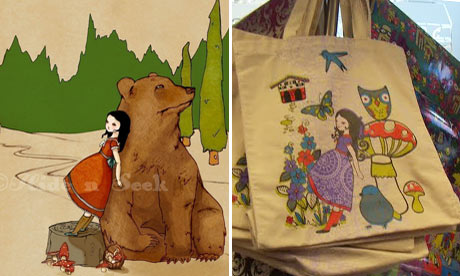
Yesterday's Guardian reports the Davina-and-Goliath battle between designer "Hidden Eloise" and stationery giant Paperchase. The designer claims (understandably, to anyone with eyes in their head) that her character in the left hand picture was copied by Paperchase in the right hand picture. She complained to the company, but they declined to cease sales and told her that they had bought the image in good faith. Here is a link to their statement, which quotes the agency they bought the artwork from, who in turn pass the buck to the individual third-party designer.

Unable, as it seems, to afford litigation, she started a Twitter campaign. According to the Guardian, it became one of the top trending stories on Twitter - something that could cause reputational damage no company can afford in the long run. The third-party designer concerned has apparently written to Hidden Eloise to apologise for copying too closely.

Moving away from the specifics of this case, in general what should a large company do when faced with the all-too-common fact that one of their products involves, to the untrained eye, a prima facie infringement of copyright and/or design right of X? To say "I bought it from Y in good faith" and carry on selling is really not good enough.

Apart from being legally and morally wrong, it is a bad commercial solution, because the company is liable when on notice, and is racking up damages which, no matter how onerous their procurement contract conditions, they may not be able to pass on to Y if Y is a small designer. If X ultimately musters the courage and the finances to sue, X, Y and the company will all lose money, and the only winners are the legal professionals. It is also a bad reputational solution, because companies selling well designed products benefit from their association in the mind of the consumer with designers whose products they market - and lose that benefit with the speed of a deflating Zeppelin when they visibly condone IP infringement.

There is only one answer - act quickly and in good faith, and take down the product while you investigate.

And for the small designer: Twitigation - an alternative to litigation?

Wednesday, January 20, 2010

China's new Supreme Court interpretation of Scope of Designs

We learn from the excellent IP NEWS published by Linda Liu & Partners that the Chinese Supreme Court has published new interpretation of the scope of patents, designs and utility models. These took effect on 1st January 2010. Articles 9 to 11 are particularly relevant to designs. A Chinese version is here.
We reproduce below, with thanks, the translations by Linda Liu & Partners, noting that those parts amended since the consultation document in June 2009 are underlined. From a European point of view, we note the "overall impression test", but also the significance of the written description of the design in defining its "essential features".

Interpretation of the Supreme People’s Court on Several Issues Concerning the Application of Law to the Trial of Patent Right Disputes
(translation by Vera WEI of Linda Liu & Partners)

Article 9 The People’s Court should determine “the scope of protection afforded by a design patent” prescribed in Article 59.2 of the Chinese Patent Act with reference to an identical or similar design with the patented design used on the identical or similar categories of product as the design patent product. Where the categories of products are identical or similar but the allegedly infringing design is not identical or similar to the patented design, or where the allegedly infringing design is identical or similar to the patented design while the categories of products are not identical or similar, the People’s Court should hold that the allegedly infringing design does not fall into the protection scope of the design patent.

Article 10 Products within the same category referred to in Article 9 of this judicial interpretation means products for the same use; products within similar categories means products for similar uses. The People’s Court can determine the use of a product by referring to the International Classification of Designs, the name and function of the product described in the brief description, and other factors such as sale and actual use of the product.

Article 11 The People’s Court should determine whether designs are the same or similar based on the perceptions of the relevant public to the product of the design. “Relevant public” referred to in the preceding paragraph means one who has basic knowledge about the conditions under which the patented design was created and is able to distinguish the divergences in shape, pattern, and color amongst different designs but who will not pay special attention to minor differences in the shape, pattern, and color of designs.

Article 12 The People’s Court should determine whether designs are the same or similar by considering the overall visual effect of designs and all the design features within scope of protection afforded by the design patent. However, the only one design feature that can achieve the technical effect of the product and those features that cannot affect the overall visual effect, such as the material and internal structures, shall not be taken into consideration. Where the allegedly infringing design and the patented design are so similar that it can confuse the relevant public, the People’s Court shall hold the allegedly infringing design is similar to the patented design. Where the allegedly infringing design does not contain the essential features of the patented design, it should be assumed that the allegedly infringing design will not cause confusion to the relevant public with regard to its overall visual effect. The essential features of a design referred to in the preceding paragraph means the features of a patented design that causes a prominent visual effect in the relevant public when compared with existing designs. The People’s Court can identify the essential feature by referring to the brief description.

Tuesday, January 19, 2010

French appellate court upholds Raindance claim

Yesterday's International Law Office release carries a casenote by Marie-Aimée de Dampierre and Camille Pecnard (Lovells LLP) on the protection of shower head designs in France.

In short, German manufacturer Hansgrohe was the proprietor of a Community design for its Raindance hand shower. Together with its French distributor, Hansgrohe sued DGK Productions Europe SARL, Carrefour Hypermarchés France SAS and MTK Import Export for design infringement and unfair competition, seeking to prevent sales of the Lagoone hand shower, which was protected as a French design.

Hansgrohe's claims were dismissed at first instance, the court holding that both parties' design registrations were invalid. Hansgrohe's Community design registration was invalid since it reproduced an earlier registered third party design. The Cour d'appel de Paris reversed this finding: while the functional features of the Raindance shower head, in particular the elastic spikes and wedges, could not be taken into account for the examination of novelty and individual character, the design was characterized by its lines, contours, chrome finishing and shape. On account of these characteristic features, the Raindance design was new and had individual character. Comparing that design with the allegedly infringing Lagoone product, even though the two had different numbers of spikes and differently-shaped wedges (which were not highly visible), the overall impression of the designs appeared similar to an informed user and Hansgrohe's design was infringed.

Unfortunately International Law Office does not provide illustrations. A picture of Raindance appears above (from which it's not clear what is meant by 'spikes' and 'wedges') , but I've been unable to dig up a picture of Lagoone at all. Can any reader oblige?

Sunday, October 4, 2009

Good news for copyright infringers, or a Trapp to Tripp designers?

This posting is by Class 99-er Henning Hartwig.

German case law isn’t famous for awarding exorbitant damages in IP infringement matters. Now, it appears as if German Courts are even going into reverse: Just published, the German Federal Supreme Court has only recently decided, in Case I ZR 98/06 Tripp-Trapp-Stuhl, that copyright infringers are not obliged to render the whole profit made with the infringing copy even when imitating one-to-one the work-in-suit (in this case, the well-known Tripp-Trapp child's chair). The court found that, in such a case, the decision of the consumer to buy the copy (and not the original) was not based “entirely on the infringement” but rather on other factors such as “functionality” or “good price” of the copy. In short, the consumer is buying the copy not only because of it being identical with the original, but because it is cheaper.

This observation doesn’t seem to be new or surprising – why should I buy a copy if it isn’t even cheaper than the original? In fact, there is most probably no copy that isn’t offered at a better price than the original. But this is no excuse for courts to let copyright infringers get away with some of their profits. Should these people really be rewarded by being allowed to keep a part of their profits because they sell their copies for less (and clearly detracting buyers from acquiring the original), whereas infringers selling their copy at the price of the original (highly unlikely, though) would have to render the entire amount of their profits? And how can a court determine and weigh factors such as “functionality”, “low price”, “imitation” etc., factors that are decisive, according to the court, for calculating the percentage to be deducted from the profits?

The decision raises more questions than it answers – including the critical question to what extent this reasoning will be transferred to other IP rights. If German courts answer this in the affirmative, Germany would indeed find itself before a change of paradigm.

Tuesday, September 1, 2009

Door opens for design owners in Italy

Lualdi's staggeringly individual door design


Trevisan & Cuonzo Avvocati report a Milan design infringement trial on RCD 153333-01 and 02. The door shown in the designs (depicted above) looks very similar to, well, any door you've ever opened but on close scrutiny you can just about see that it stands proud of the door frame. The proprietor, Lualdi S.p.A, sued Dorica Castelli S.p.A., who exhibited their own Quadro' door at a Milan trade fair. They lost in interlocutory proceedings, but succeeded in the end on the merits, over a plea that the design was invalid. It appears that their definition of the "informed user" is essentially the same as that adopted by OHIM and, to a first approximation, in the UK - "a purchaser who is particularly attentive to the goods in question but is not an architect or a designer and who does not leave the choice of purchase to another but informs himself by consulting catalogues, magazines and experts to find the product that best fits his needs".

That is in line with the majority of prior Italian cases, though in one or two apparently the "informed user" has to the contrary been seen as architect or interior designer - see Professor Mario Franzosi's excellent JIPLP article Design Protection Italian Style.

One can only applaud harmony and consistency across the EU. But is this really Italian design at its best? It is hard to tell on the basis of these grainy, monochrome grey pictures, but the design in question appears to fit right into Franzosi's pithy commentary:
"Take a look at what is registered at OHIM in Alicante. ... Most of them are not work of design because they are simply ugly."